


| Title | Contents | Editorial Board |
 |
|
|
KAVAKA 61(1): 1-6 (2025) DOI:10.36460/Kavaka/61/1/2025/1-6
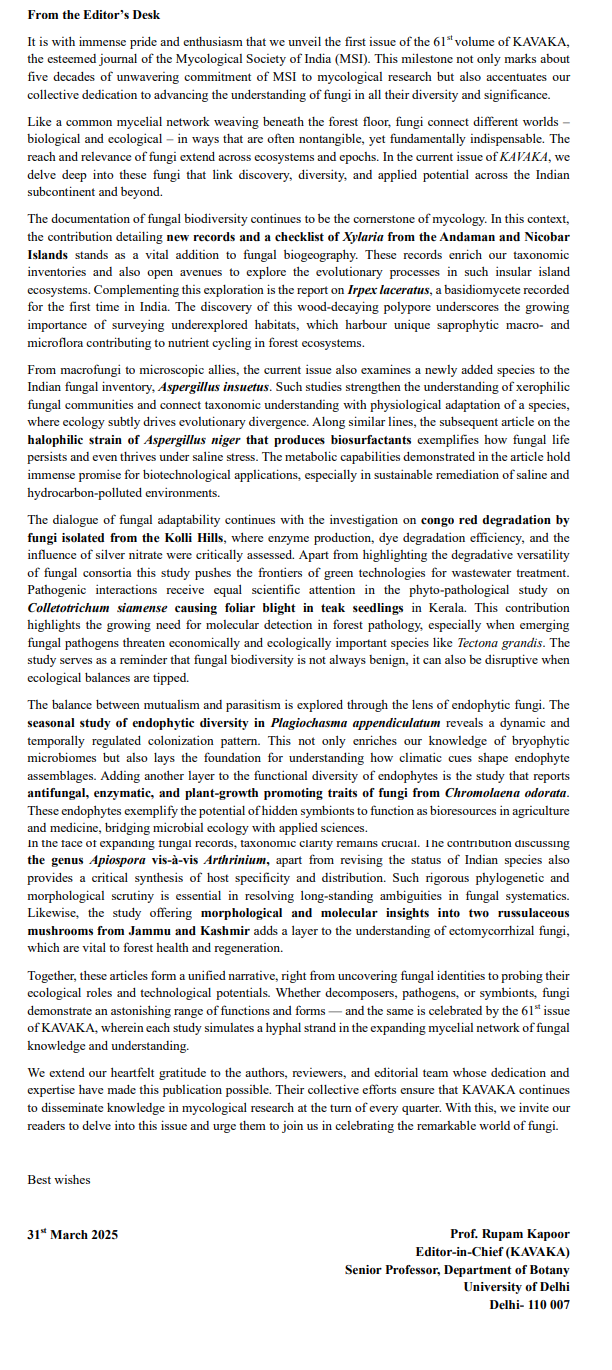
Antifungal, Enzymatic, and Plant Growth Promotion Activities of Endophytic Fungi from the Medicinal Plant, Chromolaena Odorata
Kistu Singh1*, M. Shyamkesho Singh2, and R.R. Pandey3
1Department of Botany, Kumbi College, Kumbi - 795 133, Manipur, India.
2,3Department of Life Sciences (Botany), Manipur University, Canchipur - 795 003, Manipur, India.
*Corresponding author Email: This email address is being protected from spambots. You need JavaScript enabled to view it.
(Submitted on July 13, 2023; Accepted on March 26, 2025)
ABSTRACT
Chromolaena odorata is a wild medicinal plant and most of the time neglected as a weed. In traditional medicine, C. odorata has been used to treat several ailments by different ethnic communities around the world. Medicinal plants are a storehouse of endophytic fungi which shows various biological activities. In this study, endophytic fungi were isolated from C. odorata using different parts. Four endophytic fungi were selected based on preliminary antifungal activity and assessed for their antifungal activity against ten fungal phytopathogens. Maximum inhibition percentage was shown by Trichoderma sp. 2 (100%) against A. alternata, A. flavus, C. lunata, S. oryzae, and U. virens, and least inhibition by Alternaria sp. 1 against A. brassicicola (33.11%). Three isolates were found to produce protease, lipase, and amylase enzymes. All the isolates produced ammonia, and three isolates produced hydrogen cyanide, but none of the isolates could solubilize phosphate. Strong biocontrol agents are very much needed in the recent trend of chemical-free farming practices.
Keywords: Medicinal, Endophytic, Antifungal, Phytopathogens, Biocontrol
KAVAKA 61(1): 7-16 (2025) DOI: 10.36460/Kavaka/61/1/2025/7-16
Biosurfactant Production by a Moderate Halophilic Aspergillus niger HF-1 Isolated from a Saline Lake
Shabib Khan1* and Lolly Jain1
1Department of Microbiology, K.J. Somaiya College of Science and Commerce, Vidyavihar Mumbai, (Autonomous- Affiliated to the University of Mumbai), Maharashtra, India
*Corresponding Author Email: This email address is being protected from spambots. You need JavaScript enabled to view it.
(Submitted on December 06, 2024; Accepted on March 11, 2025)
ABSTRACT
Biosurfactants are obtained from living organisms and reduce the surface tension observed in the case of liquids. They possess an advantage over synthetic counterparts as they are non-toxic and biodegradable. As compared to bacteria, there is relatively lesser scientific investigation on fungal biosurfactants; and that too from saline habitats. In this research, an attempt was made to isolate and identify a halophilic fungus capable of producing a biosurfactant. The research was based on hypothesizing the ability of halophilic fungus to utilize and emulsify Soybean and Olive oils. Using a combination of preliminary morphological studies along with 18S rRNA-based molecular methods, the fungus was identified to be Aspergillus niger HF-1. The data was uploaded on NCBI and the GenBank Accession number obtained was PP568077. The fungus could grow optimally at pH-7, at 37℃ and 3% NaCl with 2.93cm±0.11cm oil displacement, 60.33%±0.57% emulsification index, 42%±1.73% reduction in surface tension, and an initial biosurfactant yield of 0.28±0.02 g% (2.8g/L).
Keywords: Biosurfactants, Halophilic fungus, NaCl, Emulsification, Surface tension
KAVAKA 61(1): 17-26 (2025) DOI: 10.36460/Kavaka/61/1/2025/17-26
Morphological and Molecular Insights into Two Russulaceous Mushrooms from Jammu and Kashmir, India
Komal Verma, Ayushi Mahajan, Sandhya Rajput, and Yash Pal Sharma*
Department of Botany, University of Jammu, Jammu - 180 006, Jammu and Kashmir, India.
*Corresponding author Email: This email address is being protected from spambots. You need JavaScript enabled to view it.
(Submitted on January 7, 2025; Accepted on March 27, 2025)
ABSTRACT
In this study, two species belonging to the family Russulaceae, Russula aurantioflava and Lactarius kesiyae, are documented. Russula aurantioflava is reported as a new addition to the Indian mycobiota, while Lactarius kesiyae is recorded for the first time from Jammu and Kashmir, India. Comprehensive macro- and micromorphological descriptions, along with illustrations and molecular analyses based on nrITS sequences, are provided.
Keywords: Macrofungi, nrITS, New record, Phylogeny, Regional records
KAVAKA 61(1): 27-33 (2025) DOI: 10.36460/Kavaka/61/1/2025/27-33
Molecular Detection and Phyto-pathological Investigation of Colletotrichum siamense Associated with Severe Foliar Blight Disease of Teak (Tectona grandis) Seedlings in Kerala, India
Shambhu Kumar1*, Sujanapal P2, Mahadevakumar S3 and Raghvendra Singh4
1Forest Pathology Department, KSCSTE-Kerala Forest Research Institute, Peechi - 680 653, Thrissur, Kerala, India.
2Silviculture Department, KSCSTE-Kerala Forest Research Institute, Peechi - 680 653, Thrissur, Kerala, India.
3Botanical Survey of India, Andaman & Nicobar Regional Centre, Haddo - 744 102, Port Blair, India.
4Centre of Advanced Study in Botany, Institute of Science, Banaras Hindu University, Varanasi - 221 005, Uttar Pradesh, India.
*Corresponding author Email: This email address is being protected from spambots. You need JavaScript enabled to view it.
(Submitted on January 12, 2025; Accepted on February 13, 2025)
ABSTRACT
Teak (Tectona grandis) is one of the most valuable hardwoods in the world. Teak seedlings hold significant importance for various reasons, particularly in the context of forestry, environmental conservation, and economic development. Teak seedlings with a severe foliar blight infection were observed between April 2020-22 in a social forestry nursery in Thrissur, Kerala. Infected leaves displayed brownish, necrotic brightening lesions that grew larger as the disease advanced. The disease prevalence was 100%. An associated fungal pathogen was isolated and examined to determine the causative agent. Based on cultural characteristics, morphology, and multigene sequence analysis and molecular phylogenetic analysis using concatenated sequence alignment of ITS-TUB2-GAPDH, the pathogen was identified as Colletotrichum siamense. Further, Koch’s postulates were fulfilled by inoculating the healthy seedlings with isolated fungal pathogen and characteristic symptoms were recorded. The identity was confirmed after re-isolation and thus confirming its association. To the best of our knowledge, this is the first report of C. siamense causing foliar blight disease in teak seedlings from Kerala, India. This research emphasizes the need for effective disease management strategies to ensure healthy teak seedlings production for conservation programme.
Keywords: Nursery diseases, Foliar disease, Mycopathogens, Glomerellaceae, PCR
KAVAKA 61(1): 34-39 (2025) DOI: 10.36460/Kavaka/61/1/2025/34-39
Aspergillus insuetus: A New Addition to Indian Funga
Shivani Digra and Skarma Nonzom*
Department of Botany, University of Jammu, Jammu, Jammu and Kashmir, India
*Corresponding Author Email: This email address is being protected from spambots. You need JavaScript enabled to view it.
(Submitted on January 17, 2025; Accepted on January 29, 2025)
ABSTRACT
Extreme habitats provide unique conditions that foster the evolution of novel and specialized microbes including fungi. These microbes either in association or free-living exhibit a wide range of adaptations enabling them to survive in such challenging and harsh conditions. A study was conducted to explore the fungal diversity in the rhizospheric soil of Elaeagnus angustifolia L. growing wild in Kargil (Ladakh), India. Of the recovered fungal species, we hereby report a microfungi (Aspergillus insuetus) of rare distribution which was identified based on the cultural, micro-morphological and molecular characterization (nrITS). The current investigation represents the first attempt to isolate fungal species from the rhizospheric soil of E. angustifolia L. To the best of our knowledge, A. insuetus constitutes the first report to the Indian mycoflora showing a colonization frequency 6.6%..
Keywords: Rhizosphere, Taxonomy, Cold desert, High-altitude
KAVAKA 61(1): 40-49 (2025) DOI: 10.36460/Kavaka/61/1/2025/40-49
Apiospora vs. Arthrinium: Taxonomic Status of Indian Species with Special Reference to Their Host Range and Distribution in India
Sayantan Jash1 and Rashmi Dubey1*
1Botanical Survey of India, Western Regional Centre, 7 Koregaon Road, Pune - 411 001, Maharashtra, India.
*Corresponding author Email: This email address is being protected from spambots. You need JavaScript enabled to view it.
(Submitted on January 23, 2025; Accepted on March 1, 2025)
ABSTRACT
Apiospora and Arthrinium do not seem to have clear diagnostic morphological features but in a mordern studies, the combination of morphological, genetic, and ecological characteristics suggested that Apiospora and Arthrinium represent independent lineages within Apiosporaceae and thus should be considered as different genera. As per previously published literature, four species of Apiospora and nineteen species of Arthrinium were reported from India based on their morphological characters. But recently, based on polyphasic approach, a huge number of Indian Arthrinium species have been transferred to the genus Apiospora and currently only four Indian species exist under the genus Arthrinium. Therefore, in order to provide a comprehensive data of Indian Apiospora and Arthrinium, a thorough study was conducted based on field survey, literature review and phylogenetic analysis of deposited published sequences. The recent study deals with the current taxonomic status of Indian species of Apiospora and Arthrinium along with their comparative morphological account, host range and distribution.
Keywords: Apiosporaceae, Comparative morphology, Host families, nr-ITS, Polyphasic approach
KAVAKA 61(1): 50-54 (2025) DOI: 10.36460/Kavaka/61/1/2025/50-54
Irpex laceratus (N. Maek., Suhara & R. Kondo) C.C. Chen & Sheng H. Wu (Basidiomycota: Polyporales: Irpicaceae): A New Record from India
Anjali Rajendra Patil, Yogesh Sadashiv Patil* and Mrunalini Ajitkumar Vedpathak
Department of Botany, Rajaram College, Kolhapur - 416 004, Maharashtra, India.
*Corresponding author Email: This email address is being protected from spambots. You need JavaScript enabled to view it.
(Submitted on January 28, 2025; Accepted on March 22, 2025)
ABSTRACT
A Irpex species was collected during a field survey in Kolhapur district, Maharashtra, India. Based on Macro-micro morphological characteristics, the species was identified as Irpex laceratus. A literature review confirms this to be the first record of the species from India.
Keywords: Irpex, Polypore, White rot, India
KAVAKA 61(1): 55-74 (2025) DOI: 10.36460/Kavaka/61/1/2025/55-74
New Records and a Checklist of Xylaria from Andaman and Nicobar Islands
Niranjan, M1&2. and Sarma, V.V.1*
1Department of Biotechnology, Pondicherry University, Kalapet - 605 014, Pondicherry, India.
2 Dharmavana Centre of Excellence for Biodiversity & Climate Resilience, Telangana, India.
*Corresponding author Email: This email address is being protected from spambots. You need JavaScript enabled to view it.
(Submitted on January 29, 2025; Accepted on March 9, 2025)
ABSTRACT
Xylaria is a macro ascomycetous genus distributed worldwide. Examination of dead and decaying twig samples of tree plant species fallen on the forest floor in the South, Middle, and North Andaman Islands of India yielded 18 new records of Xylaria species from the Island region. This paper describes and illustrates these with a table showing a Xylaria spp., checklist from the Andaman Islands.
Keywords: Andaman Islands, Ascomycota, Sordariomycetes, Taxonomy, Xylariomycetidae,
KAVAKA 61(1): 75-82 (2025) DOI: 10.36460/Kavaka/61/1/2025/75-82
Evaluation of Enzyme Activities, Dye Degradation and Effect of Silver Nitrate on Bioremediation of Congo Red by Fungi Isolated from Kolli Hills
Sabarish Sathyalingam1, Elumalai S2, Kumaresan S1, and Kathiravan Govindarajan1*
1Department of Botany, Ramakrishna Mission Vivekananda College, Mylapore, Chennai - 600 004, Tamil Nadu, India. (Affiliated to University of Madras, Chennai 600005, India)
2University of Madras, Chepauk, Chennai - 600 005, Tamil Nadu, India.
*Corresponding author Email: This email address is being protected from spambots. You need JavaScript enabled to view it.
(Submitted on February 25, 2025; Accepted on March 13, 2025)
ABSTRACT
Fungi are known to produce a number of compounds, including some industrially important enzymes. The aim of this study was to isolate and identify fungal species from leaf litter in Kolli hills region and evaluate their ability to degrade Congo red dye, a synthetic pollutant. In the current study, two fungal strains were isolated from the leaf litter of Kolli hills and identified as Aspergillus niger and Colletotrichum acutatum. The fungal strains were evaluated for their potential to produce cellulase and xylanase enzymes. The isolates were found to produce both the enzymes, with Aspergillus niger showing increased activity. A. niger and C. acutatum showed 95% and 92% of Congo red dye degradation respectively, which is highly efficient. The Decolourization of Congo red was found to be negatively influenced by the presence of silver nitrate. The optimum temperature for dye decolourization was found to be 30℃ for C. acutatum and 35℃ for A. niger. Fungal communities inhabiting leaf litter play crucial roles in nutrient cycling and ecosystem functioning. Additionally, their potential for degrading environmental pollutants presents promising avenues for bioremediation strategies.
Keywords: Aspergillus niger, Colletotrichum acutatum, Cellulase, Kolli hills, UV-spectrophotometer, Silver nitrate, Xylanase.
KAVAKA 61(1): 83-94 (2025) DOI:
Seasonal Variations of the Endophytic Fungal Diversity Associated with the Liverwort
Plagiochasma appendiculatum Lehm. & Lindenb.
Megha Sethi1, I.B. Prasher1, Sunita Kapila*
1Department of Botany, Panjab University, Chandigarh -160 014, India
*Corresponding author Email: This email address is being protected from spambots. You need JavaScript enabled to view it.
(Submitted on February 28, 2025; Accepted on March 28, 2025)
ABSTRACT
This study investigates the diversity, colonization patterns and the seasonal variations in the fungal microbiome colonies associated with the liverwort Plagiochasma appendiculatum Lehm. & Lindenb. Altogether 17 different taxa of endophytic fungi dominantly belonging to the phylum Ascomycota and class Sordariomycetes, have been identified from 333 fungal isolates recovered from the thallus well as the rhizoids of the liverwort. Pyrenopolyporus tonngachengensis, the most abundant species recovered from our liverwort in P. appendiculatum is reported as an endophyte for the first time and it has been recovered from both the thalli as well as the rhizoids. However, the colonization rate was higher in the thalli (75.1%) as compared the rhizoids (24.9%), which can be most likely attributed to the larger surface area and nutrient availability for their growth in the thallus, further reaffirmed by the higher values of the ecological and diversity indices for thallus than the rhizoids. Present study also revealed the seasonal fluctuations in the diversity of the endophytic fungi across the year. Highest species richness was observed during summers, while the greatest colonization frequency was documented during winters, validating that the environmental factors such as humidity, temperature and physiology of host greatly affect the fungal endophytic community associated with the host.
Keywords: Ascomycota, Sordariomycetes, Liverwort thallus, Ecological indices, Seasonal variability


